
Kyle Flemmer: The Intersection of Experimental Literature and Digital Art
By Darren Smith
August 17, 2026
In a quiet residential street in Calgary, on the traditional territories of the Treaty 7 Nations, a writer sits at a desk that faces two directions at once. On one side of the desk rest carefully stacked limited-edition chapbooks, typewritten visual poems printed on heavy stock, and trade poetry collections issued by some of Canada’s most respected independent presses. On the other side, multiple browser windows remain open to Tezos marketplaces, where pixelated glitches, corrupted video-game sprites, and fully on-chain artworks change hands for modest amounts of cryptocurrency. The man who moves between these two environments with unusual ease, consistency, and seriousness is Kyle Flemmer, known to literary readers under his own name and to a growing international community of digital art collectors as @WildMissingNos.
Flemmer is not a loud presence in either world. He does not court controversy. He does not chase algorithmic attention. He does not issue grand manifestos or position himself as a revolutionary figure. He does not seek the spotlight. Yet over the course of more than a decade he has constructed one of the most coherent, formally rigorous, ethically considered, and cross-disciplinary practices currently operating at the intersection of Canadian experimental literature and blockchain-based art. His work returns, again and again, to a deceptively simple but profound question: what happens when the systems that organize knowledge, language, commerce, technology, and value begin to malfunction? In Flemmer’s hands, the glitch is never treated as a mere failure, accident, or error message. It becomes a generative site, a place where new forms of meaning, ownership, attention, and relation can appear.
This is the story of a writer and artist who treats barcodes, Wikipedia hyperlinks, lunar flags, and the most famous glitch in the history of Pokémon as equally legitimate materials for serious creative work. It is the story of someone who has built both an independent small press and a carefully designed blockchain project around the same set of formal and ethical concerns. It is the story of a practice that refuses the usual separations between literature and digital art, between the handmade object and the on-chain token, between rigorous conceptual work and genuine playfulness. Readers can learn more about the full scope of his activity at his personal site, kyleflemmer.com.

From Concordia to Calgary: The Formation of an Experimental Writer
Kyle Flemmer’s path into experimental writing began in Montreal. At Concordia University he completed a double major in Western Society & Culture and Creative Writing. At the time, Montreal’s Anglo literary scene was characterized by a dense and lively ecosystem of zines, independent bookstores, reading series, underground publishing projects, and a healthy suspicion of mainstream commercial publishing. The influence of that environment remains visible throughout Flemmer’s career. It can be seen in his lasting preference for limited-edition physical objects, his commitment to keeping work accessible rather than artificially scarce, and his willingness to treat the book itself as a site of formal experiment rather than a neutral container for text.
After completing his undergraduate studies, Flemmer moved west to Calgary, where he pursued graduate work at the University of Calgary. For decades the university has been recognized as one of the most important centers for experimental, conceptual, and innovative poetry in Canada. Flemmer’s 2022 Master of Arts thesis, titled Cyborg Reading: Transmedial Digital Poetry and the Cyborg Milieu, examined the ways computer mediation, materiality, source code, and interface design reshape the relationships between writers, readers, and literary texts. Drawing on critical posthumanism and cyberfeminist reading practices, the thesis argued for a mode of “cyborg reading” capable of attending to features that conventional literary criticism often overlooks or dismisses.
By then Flemmer had already founded a press, served as an editor at a respected magazine, published multiple chapbooks with various small presses across Canada, and begun developing the procedural, visual, and constrained techniques that would define his later books. What is striking about his trajectory is its consistency of attention. From the beginning he has treated writing, editing, publishing, and digital making as interconnected activities rather than separate domains. The same intelligence that shapes a typewritten visual poem also shapes a fully on-chain sprite and a carefully designed limited-edition anthology.
The Blasted Tree: Building a Press on Dual Principles of Care and Access
In 2014, while still a relatively young writer, Flemmer founded The Blasted Tree Publishing Co.. The name carries a quiet but deliberate resonance. It evokes the “blasted trees” that appear in Romantic landscape painting as symbols of both damage and stubborn resilience, while also suggesting something alive that continues to grow from broken or difficult ground. From its inception the press was conceived as more than a vehicle for Flemmer’s own writing. It was designed as a platform for experimental writing and visual art by Canadian and international authors, with particular attention paid to the physical and material qualities of the book object.
Flemmer has repeatedly described the operating model of The Blasted Tree as “high production value on a shoestring budget.” The press produces carefully designed limited-edition print runs while simultaneously making digital versions of the work freely available online. This dual commitment—to the handmade, tangible, collectible object and to open access—has become a defining feature of his broader practice. The Blasted Tree publishes poetry, visual poetry, short fiction, drama, graphic narrative, creative nonfiction, and multimedia work, always with an emphasis on formal risk, material intelligence, and collaborative possibility. More information about the press and its catalogue can be found on its official website and through profiles such as those maintained by the Toronto International Festival of Authors.
Between 2018 and 2020, Flemmer served as Managing Editor of filling Station, Calgary’s long-running experimental literary magazine. The role placed him at the center of a community of writers interested in work that refused conventional narrative expectations and lyric conventions. He coordinated events, worked closely with emerging and established authors, and helped sustain the magazine’s reputation as a genuine space for formal experimentation. Over more than a decade, The Blasted Tree has published well over a hundred authors and artists. It remains independently operated and continues to prioritize collaborative, innovative, and visually engaged projects.
Barcode Poetry: Turning the Language of Commerce into Formal Constraint
Flemmer’s first full-length book, Barcode Poetry, published by The Blasted Tree in 2021, announced his mature concerns with unusual clarity and force. The collection consists of a 101-part sequence of typewritten visual poems. Each piece begins as a single line of text—drawn from company slogans, song lyrics, protest chants, and pieces of writing advice—then is repeated vertically down the page in order to mimic the appearance of a barcode. A final line of numbers appears at the bottom of each poem, completing the visual resemblance to the ubiquitous commercial form.
The poems were composed on a 1940 Remington Rand Deluxe Model 5 typewriter. The analogue irregularities of the machine remain visible on every page. This deliberate friction between the industrial, standardized, machine-readable form of the barcode and the handmade, imperfect quality of the typewriter creates a productive tension at the heart of the book. The work critiques the commercialization of culture and the reduction of language to scannable data while refusing to abandon the pleasures of careful making. A thoughtful review of the collection appears in The Temz Review. An earlier pre-sale campaign for the book can still be viewed on Indiegogo.
Supergiants: Looking at the Stars in Order to See Ourselves More Clearly
In April 2025, Flemmer released Supergiants, his first trade poetry collection, with Wolsak & Wynn under the Buckrider Books imprint. The book marked a significant expansion of both scale and ambition. For millennia human beings have looked upward and projected stories, desires, fears, and myths onto the night sky. In Supergiants, Flemmer deliberately reverses the direction of that gaze. What does our reach for the stars actually reveal about us as a species?
The collection works extensively with the technical language of engineering and astrophysics. Major sequences such as “Modular Systems,” “Lunar Flag Assembly Kit,” “Astral Projection,” “Coronagraphic,” and “Stellar Sequence” combine found text, visual poetry, procedural methods, and collage techniques. Families of asteroids expand on the page to contain not only physical and scientific attributes but also mythic narratives and the biographies of real people. The fate of the flags left behind by various lunar missions becomes a recurring and quietly devastating motif.

Flemmer draws on sources ranging from NASA technical documentation to the writings of Carl Sagan. Critics and interviewers have noted the book’s humor alongside its conceptual seriousness. Influences include Diane Ackerman’s The Planets: A Cosmic Pastoral and the work of Canadian poet Alice Major. A detailed conversation about the collection appears on the New Books Network, and a thoughtful review can be read at Strange Horizons. Additional bibliographic details are available through 49th Shelf.
The Wiki of Babel: Chance Operations in an Age of Collective Knowledge
Flemmer’s most recent book, The Wiki of Babel, published by the University of Calgary Press in June 2026, may be his most conceptually elegant and culturally timely work to date. The project has its roots in a high-school pastime known as “Wiki Racing”—a competitive game in which players attempt to travel between two unrelated Wikipedia pages using only the blue hyperlinks contained in the body text of articles.
During the early months of the pandemic, while recovering from COVID-19, Flemmer returned to the game and began taking careful notes on the paths he followed. He quickly realized that the notes themselves already possessed many of the qualities of poems. The Wiki of Babel is constructed from a series of constrained procedures conducted across Wikipedia. One major sequence, “Suggested Languages,” draws explicit inspiration from the biblical story of the Tower of Babel and from Jorge Luis Borges’s “The Library of Babel.” Another sequence, “Current Events,” uses Wikipedia’s current-events portal, a random-number generator, and a text-line shuffler to produce sonnets.

Flemmer has publicly described Wikipedia as “a bastion of free, public, accessible, and factual information,” and in the book’s acknowledgments he encourages readers to support the Wikimedia Foundation. A substantial profile of the book and its author appeared in the Calgary Herald. The University of Calgary Press edition is distributed by University of Toronto Press Distribution.
Entering the Blockchain: The Birth of @WildMissingNos and the Wild MissingNos. Project
Around 2023, Flemmer expanded his practice onto the Tezos blockchain under the handle @WildMissingNos. The name is a direct and knowing reference to MissingNo., one of the most famous and culturally significant glitches in the history of video games.
In the original Pokémon Red and Blue versions, a specific sequence of player actions causes the game to attempt to load data for a Pokémon species that does not exist. The entity appears as a scrambled, chaotic mix of pixels. Encountering it corrupts the graphics of the Hall of Fame and duplicates the sixth item in the player’s inventory. The glitch became legendary among players in the late 1990s and has remained a cultural touchstone for discussions of error, emergence, and unintended consequences. Full technical details are documented on Bulbapedia.
![𝘥[S T I L L] · 065](https://i0.wp.com/8bitcrypto.com/wp-content/uploads/2026/08/%F0%9D%98%A5S-T-I-L-L-%C2%B7-065.webp?resize=800%2C750&ssl=1)
Flemmer treats MissingNo. as generative material rather than simple nostalgia. Early works in the Wild MissingNos. series were produced by a custom program he wrote, then manually edited and animated. Later batches employed algorithms designed to reproduce the visual characteristics of the original glitch more faithfully. The collection can be viewed on objkt.com. Individual pieces and the broader project appear on Flemmer’s objkt profile.
The most conceptually ambitious element of the project is the Wild MissingNos. Game Warden Collector Badge. Unlike standard NFT editions, the badge functions as a key or access mechanism. Purchasing it unlocks the Wild MissingNo. Reserve and entitles the owner—referred to as the “Game Warden”—to all the holdings contained in that reserve. In mid-2026 a collector acquired the badge, and Flemmer transferred the full contents of the reserve, describing the outcome as the fulfillment of the project’s original design.
Pixel Culture, Collaboration, and a Sustained Practice of Generosity
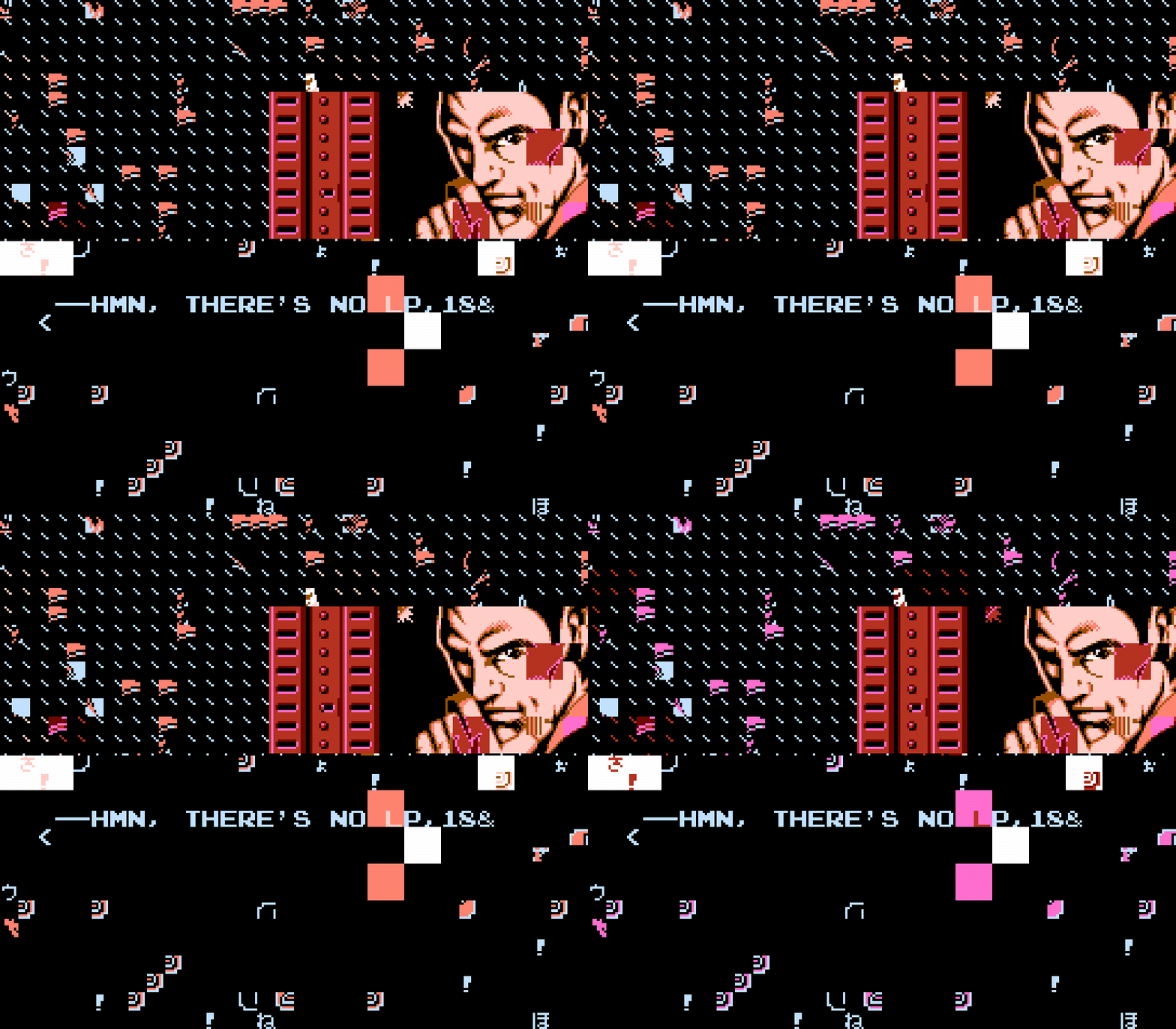
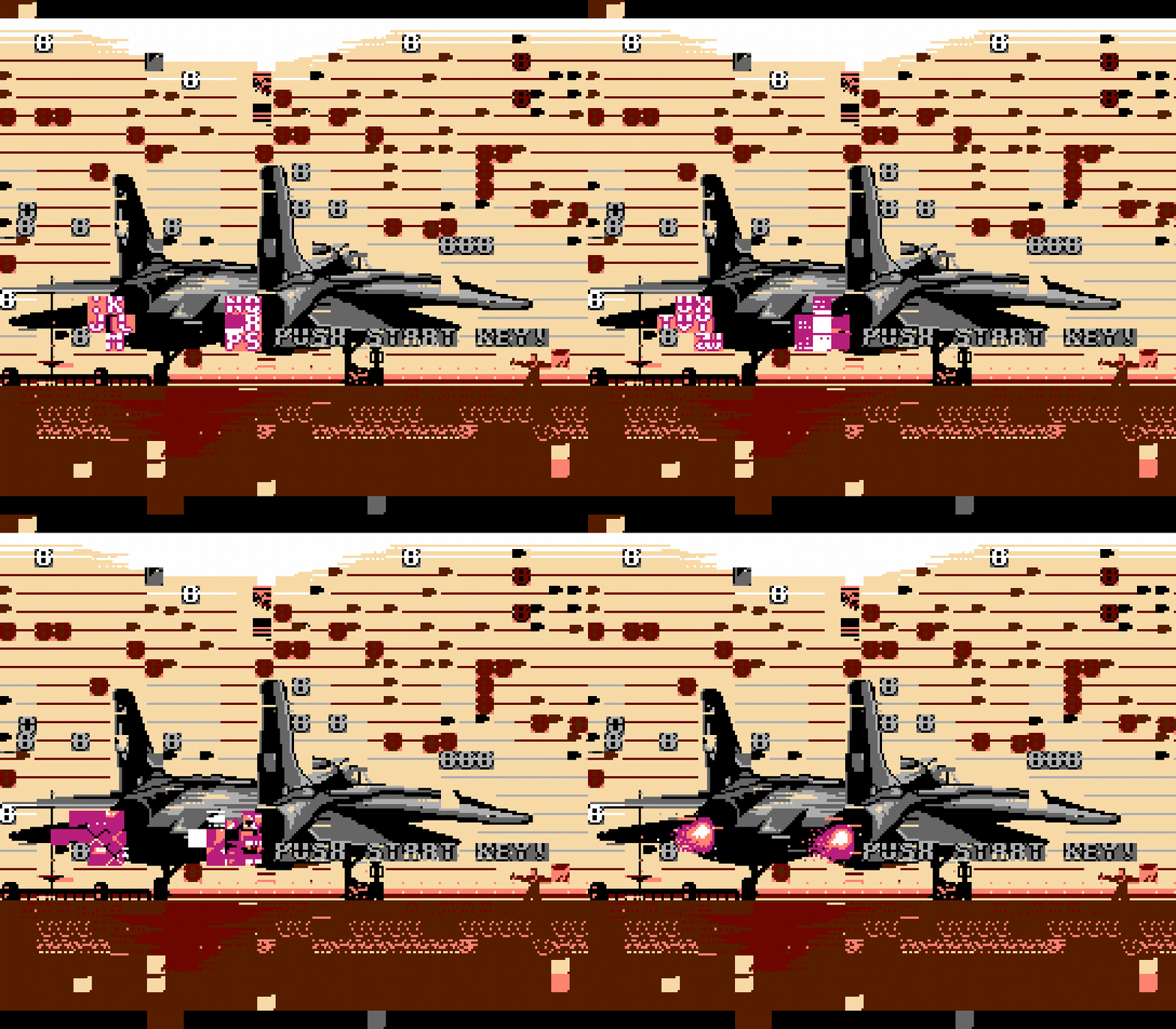
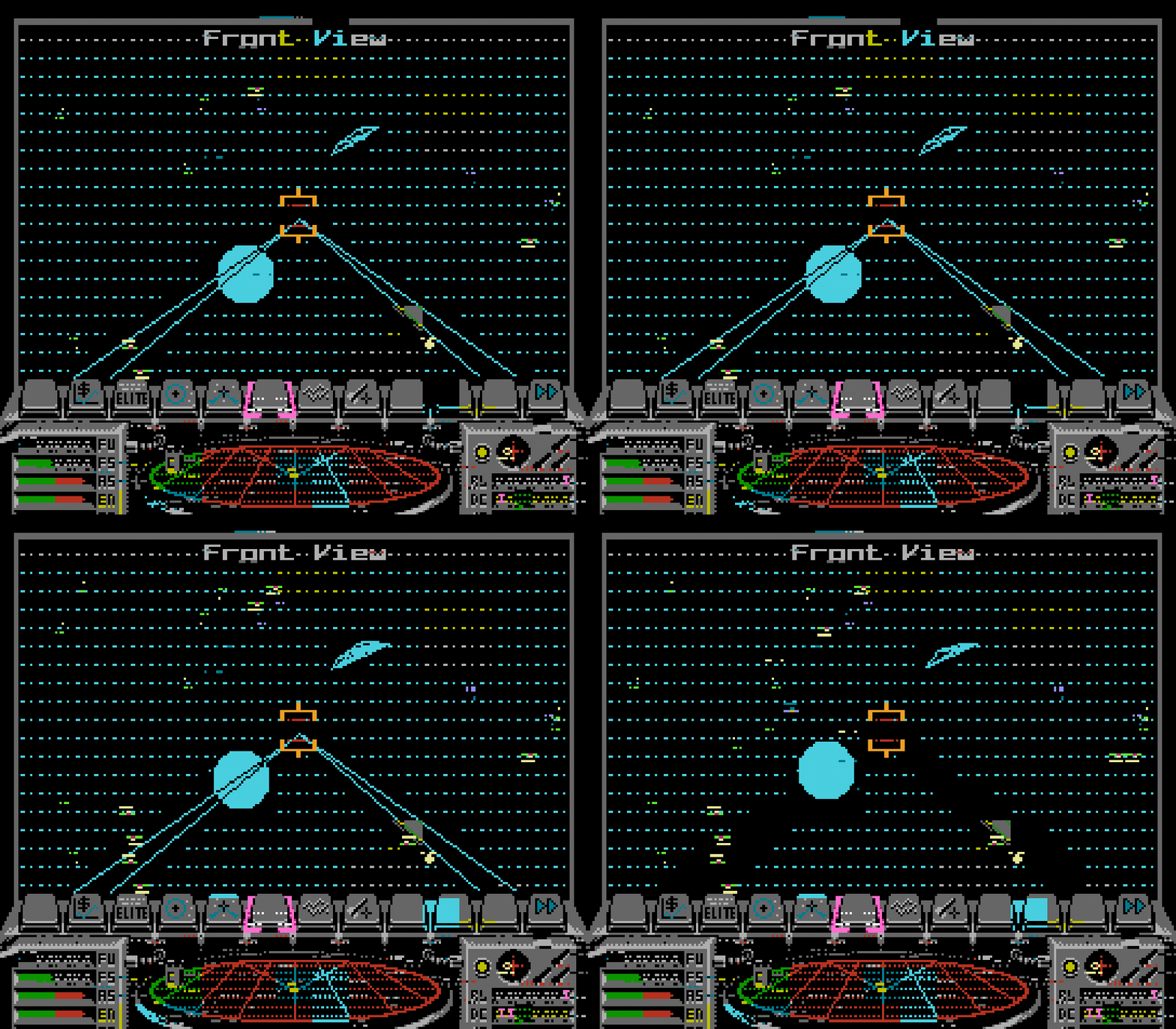
Flemmer’s activity on Tezos extends well beyond the MissingNos. project. He has produced series such as d[S T I L L], which extracts high-resolution still frames from corrupted PlayStation 1 game ROMs, and dense CMYK collages assembled from sprites found in licensed, unlicensed, and bootleg Nintendo Entertainment System games. He has created custom digital brushstrokes that other artists can use inside community tools such as the Mederu atelier. His work has appeared in group exhibitions and he regularly participates in community-organized events such as #objkt4objkt, Proof of Palm, and WALLS.
![Grand Valley [East Section]](https://i0.wp.com/8bitcrypto.com/wp-content/uploads/2026/08/Grand-Valley-East-Section.gif?resize=800%2C600&ssl=1)
Equally significant is his role as an active collector and public supporter of other artists. In 2025 he edited, designed, and published TzAR (Tezos Art Review): Pixel Art Anthology through The Blasted Tree. The limited edition of 200 copies features more than fifty artists from around the world and includes a foreword by the artist and writer known as pocobelli. Flemmer has also written a series of critical essays under the banner “Tezos Art Review.” These pieces examine individual artworks and broader themes of collaboration, friendship, and the social dynamics of the Tezos scene. His Instagram account, @kyle_flemmer, offers additional documentation of both literary and digital projects.
Systems, Glitches, and the Ethics of Attention
Across more than a decade of work in multiple media, certain preoccupations return with remarkable consistency. Flemmer is drawn to systems of various kinds: the barcode as commercial and logistical interface, the hyperlink structure of Wikipedia, the technical language of space exploration and engineering, the error-prone code of early video games, and the economic and social protocols of blockchain platforms. He approaches these systems neither with pure critique nor with uncritical celebration, but with a combination of rigorous formal attention and genuine playfulness.
Chance operations, constrained writing, visual poetry, algorithmic generation, and on-chain mechanics are tools rather than ends in themselves. The larger goal is often to make the infrastructure of knowledge, technology, language, and value newly perceptible to readers and collectors. In an era when creative practice is frequently siloed by medium, platform, market category, or academic discipline, Flemmer’s career demonstrates the generative potential of refusing those separations.
His books exist as carefully produced physical objects that reward close looking, handling, and rereading. His blockchain works exist as immutable entries on a public ledger that can be collected, transferred, and stewarded in novel ways. Between these two modes of existence lies a consistent intelligence: curious about how meaning is organized, skeptical of purely commercial logics, attentive to material and technical detail, and open to the productive possibilities of error, accident, and glitch.
A Practice Still Unfolding
As of August 2026, Kyle Flemmer continues to move between the worlds of experimental literature and digital art with the same quiet consistency that has characterized his career from the beginning. The Wiki of Babel is now available from the University of Calgary Press. New works continue to appear on Tezos. The Blasted Tree remains an active and independent press. The Wild MissingNos. Reserve has found a new steward through the acquisition of the Game Warden Badge.
Flemmer does not present himself as a revolutionary, a visionary, or a central figure in either of the communities he inhabits. He simply continues to make work that treats systems as legitimate material, glitches as opportunities rather than failures, and community as something worth sustaining through concrete acts of attention, support, and careful making. In doing so, he has created one of the more interesting, formally rigorous, and ethically considered cross-media practices currently operating at the intersection of Canadian experimental poetry and the global blockchain art ecosystem.
The glitch, in his hands, is never merely a breakdown or an error message. It is a place where something unexpected, and sometimes quietly beautiful, can still appear. It is a reminder that systems are never as closed or as complete as they appear, and that within their failures new possibilities of form, relation, and meaning can still emerge. Flemmer’s work does not claim to solve the problems of systems. It simply stays with them long enough to notice what else they might contain, and to make that noticing available to others through poems, books, sprites, and carefully designed mechanisms of ownership and care. Further updates on his ongoing projects can be followed via his X account, personal website, objkt profile, and The Blasted Tree.
