
NFT Market Analysis: Trends and Insights for 2026
By Darren Smith
August 12, 2026
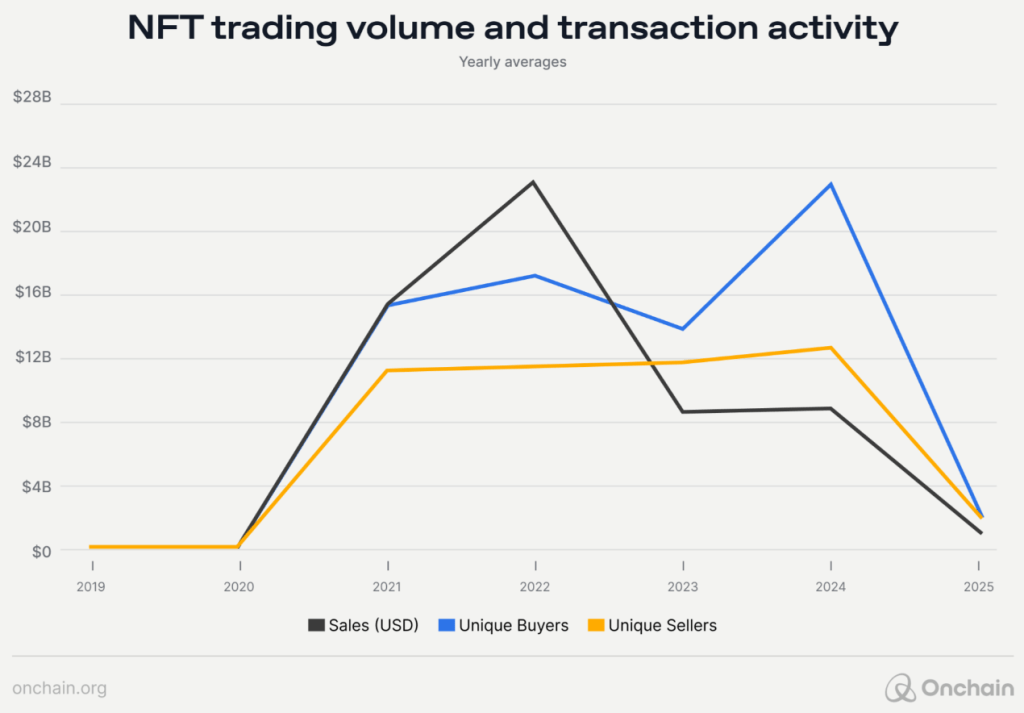
As of mid-August 2026, the global NFT market continues to operate far below its historic peaks while showing signs of structural consolidation. Data from major trackers indicates a market capitalization hovering around $1.4 billion to $1.7 billion across tracked chains, according to CoinGecko statistics from recent months. This represents a decline of more than 90% from the 2022 highs. Annual trading volume for 2025 settled near $5.5 billion, down roughly 37% from the prior year and dramatically lower than the tens of billions seen during the boom.
Daily and weekly volumes in early August 2026 have typically ranged in the low millions of dollars. CryptoSlam-accessible data showed daily sales volumes around $4.5 million to $4.8 million in the first days of the month, with transaction counts in the 20,000 to 24,000 range. Recent 24-hour volumes across major platforms have frequently landed between $3 million and $8 million. The broader crypto market pullback on August 11 saw the NFT sector drop more than 25% in a single day, according to SoSoValue data, underscoring ongoing sensitivity to wider market conditions.
A Market Defined by Concentration
Liquidity and attention have concentrated heavily around a small number of blue-chip collections and established marketplaces. CryptoPunks remains the clear leader by market capitalization, frequently cited near or above $500 million to $600 million, with floor prices in recent weeks fluctuating around 30-32 ETH. Individual sales continue to occur in the tens of ETH range, including notable transactions exceeding 30 ETH as recently as August 12. Bored Ape Yacht Club (BAYC) and related Yuga Labs projects maintain secondary positions, while Pudgy Penguins stands out for its successful expansion into physical products available at major retailers such as Walmart and Target.
Ethereum continues to dominate overall market depth and value, capturing a substantial share of residual volume. Solana maintains relevance particularly in gaming-oriented and tokenized collectibles, while Bitcoin Ordinals occupy a smaller niche. The long tail of thousands of collections from the 2021-2022 era shows near-zero activity, with many projects effectively dormant.
Marketplace Dynamics in 2026
Trading infrastructure has also consolidated. OpenSea has worked to regain share through its OS2 platform updates, fee reductions (in some cases to 0.5%), and expanded multi-chain support. Magic Eden retains strength on Solana and certain multi-chain efforts, while Blur continues to serve professional traders focused on Ethereum blue chips and NFT-Fi activity. Smaller platforms struggle for meaningful volume as liquidity pools deepen around the largest venues.

Centralized exchange NFT marketplaces have largely retreated. Binance announced the shutdown of its NFT marketplace earlier in 2026, following similar moves by other major platforms in prior years. This shift has reinforced the importance of decentralized or specialized venues and self-custody.
From Speculation to Utility and Real-World Assets
The defining theme of the 2026 NFT landscape is the pivot away from pure speculation toward utility, intellectual property, and real-world applications. Pudgy Penguins exemplifies this transition. Under leadership focused on brand building, the project has generated revenue through physical toys, animated content, and retail partnerships independent of secondary market trading. Similar efforts appear across gaming, tokenized trading cards, and brand loyalty programs.
Solana has seen notable activity in tokenized trading cards and related gacha-style mechanics, with monthly volumes in specialized segments reaching tens of millions of dollars at peaks earlier in the year. Broader real-world asset (RWA) tokenization continues to attract interest, though pure art and profile-picture (PFP) categories remain subdued compared to their earlier dominance.
Analysts describe the current market as “K-shaped”: a small group of resilient projects and long-term collectors maintain activity and value, while the majority of speculative assets from the previous cycle have lost nearly all liquidity. Average sale prices have compressed significantly from earlier peaks, reflecting both lower demand and a higher volume of lower-priced transactions in some periods.

Regulatory, Security, and Macro Headwinds
Ongoing regulatory scrutiny of crypto assets, periodic security incidents, and the broader performance of Bitcoin and Ethereum continue to influence sentiment. When major cryptocurrencies weaken, NFT volumes and floors often follow. Conversely, periods of relative stability in the wider market have supported modest rebounds in blue-chip floors, such as the sector gains observed in late July 2026.
Projections for overall market size vary widely depending on methodology. Some industry reports forecast multi-billion-dollar valuations by including broader digital asset and utility use cases, while narrower marketplace revenue estimates remain more modest, in the hundreds of millions for 2026. User numbers are expected to grow gradually but penetration remains low relative to global internet users.
Looking Ahead
The NFT market of August 2026 is no longer a mass retail phenomenon or a primary vehicle for rapid speculative gains. It functions more as a specialized collectibles and digital ownership layer within the larger blockchain ecosystem. Blue-chip projects with strong communities, proven IP, or real-world revenue streams retain the most resilient demand. Marketplaces that adapt through lower fees, better user experiences, and multi-chain support are capturing the remaining volume.
For participants, the environment rewards selectivity, fundamental analysis of projects beyond floor price, and a longer time horizon. While daily volumes remain a fraction of the 2021-2022 peaks, the persistence of trading, the survival of iconic collections, and the expansion into utility applications demonstrate that NFTs as a technology and asset class have not disappeared. They have simply matured into a quieter, more focused phase.
Collectors and observers can track ongoing activity through platforms such as CoinGecko NFT stats, OpenSea, CryptoSlam, and specialized analytics from sources including DappRadar and The Block. As the broader crypto market evolves through the remainder of 2026, the NFT sector will likely continue reflecting both the challenges and the gradual institutionalization of digital ownership.
Crypto Disclaimer: This article is for informational and entertainment purposes only. It does not constitute financial, investment, or legal advice. Cryptocurrencies and NFTs are highly volatile and involve significant risk of loss. Always do your own research. The cover image in this article was AI-generated.
